Typhoid fever remains an important public health challenge in South Asia, where the emergence and spread of antimicrobial-resistant strains of Salmonella enterica serovar Typhi (S. Typhi) increasingly complicate disease control and treatment efforts. Whole-genome sequencing (WGS) offers a powerful way to investigate cases and outbreaks beyond simply pathogen identification. By analysing genetic information, public health teams can determine which strains are circulating, detect antimicrobial resistance, investigate whether cases may be linked, and track the spread of important lineages across communities and borders.
These applications were brought to life during the “Bacterial Genomics & Outbreak Investigation” workshop, held from 12-19 August in Dhulikhel, Nepal. Over six days, 14 participants from Nepal and Bangladesh took part in lectures, hands-on exercises, and group work designed to follow the journey from raw sequencing data to actionable public health insights. At the heart of the training was a real-world dataset: whole-genome sequences from cases associated with an S. Typhi outbreak identified in Nepal in 2018. This dataset provided a common thread throughout the workshop, allowing participants to progressively build the evidence and skills they would ultimately need to investigate a simulated outbreak.
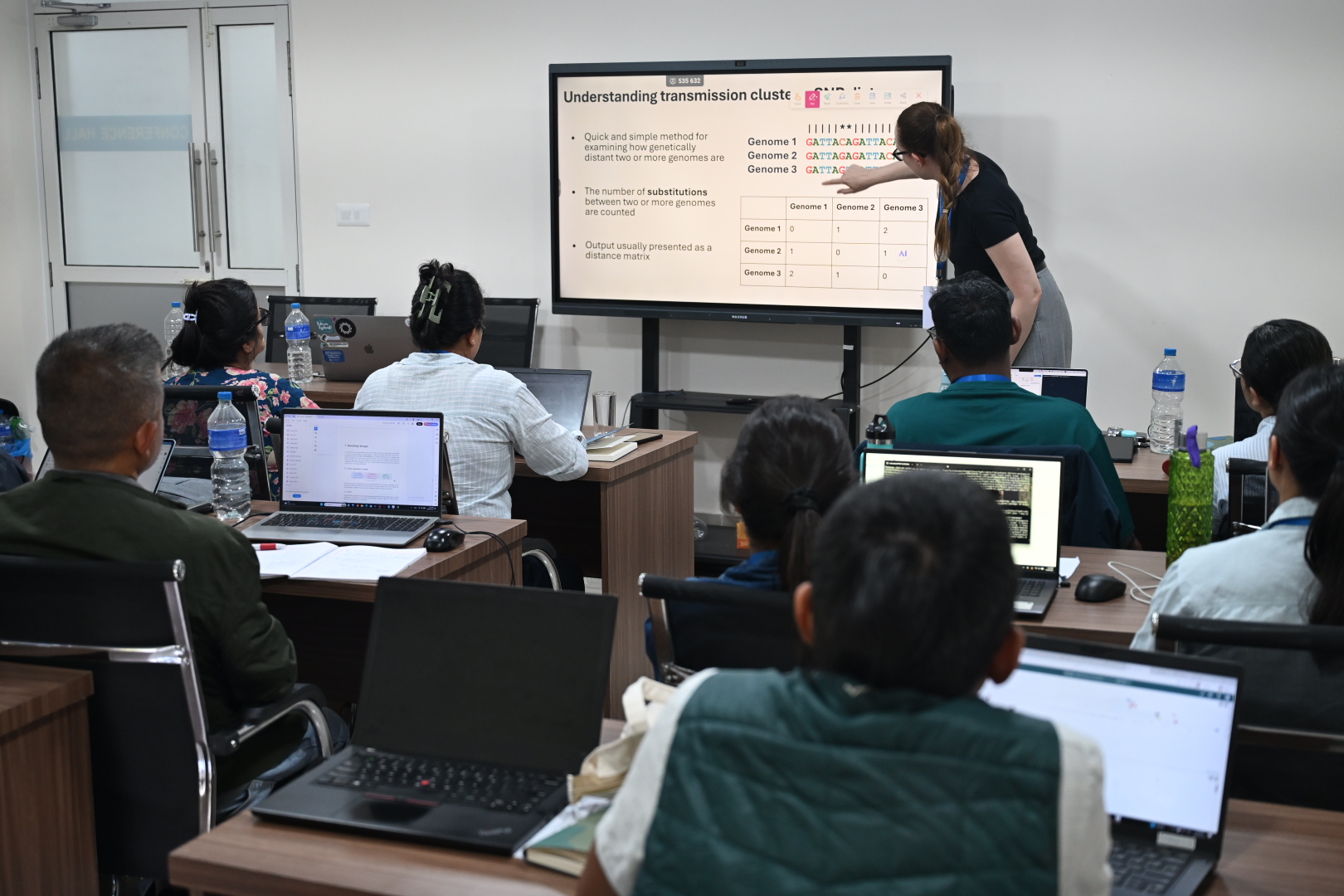
Asst. Prof. Zoe Dyson delivers a lecture on using pathogen genomics to analyse disease transmission.
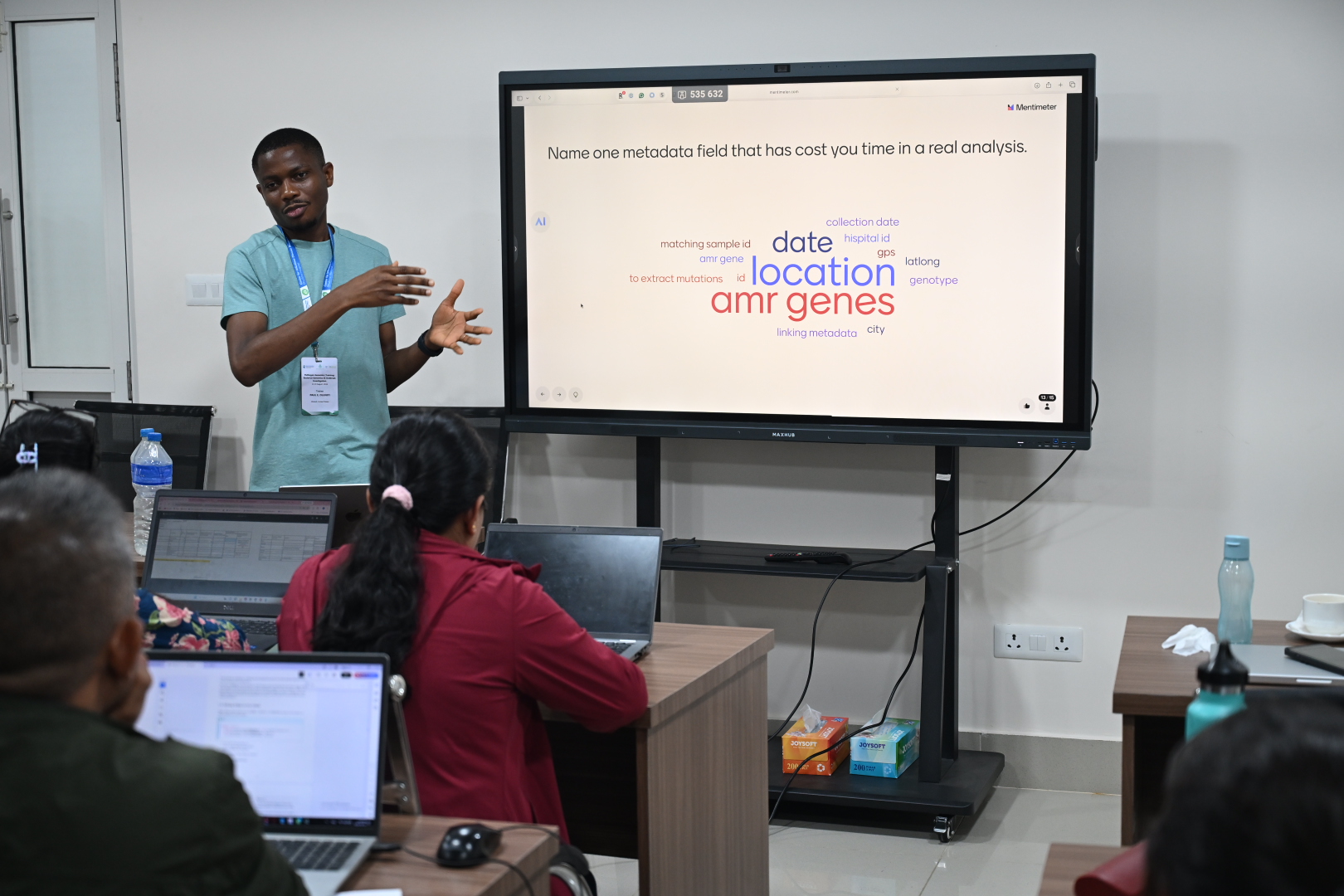
Dr. Paul E. Oluniyi facilitates a group discussion on metadata fields used in pathogen genomics.
The training was structured around three interconnected modules: Quality Assessment & Genome Assembly, Antimicrobial Resistance (AMR) Genomics, and Phylogenetic Analysis & Outbreak Investigation. Working with sequences from samples from the 2018 outbreak, participants first assessed the quality of their sequencing data and reconstructed bacterial genomes, then investigated genetic markers of antimicrobial resistance, before comparing genomes and exploring their evolutionary relationships through phylogenetic analysis. Each module combined lectures with practical exercises, enabling participants to generate and interpret a new layer of information about the same set of S. Typhi samples.
The different pieces of the puzzle came together in the workshop’s capstone simulated outbreak investigation. Participants drew on the genomic evidence they had generated throughout the three modules and combined it with epidemiological information revealed during the simulation. Working as outbreak investigation teams, they were challenged to interpret the evidence collectively, determine how cases might be connected, develop hypotheses about transmission, and translate their genomic findings into public health conclusions and recommendations.
“In this way, the exercise demonstrated not only how bacterial genomes are analysed, but how genomic epidemiology can support real-world outbreak investigation and decision-making.” – Dr. Miruna Rosu, Asia PGI Academy lead and outbreak investigation trainer.
Workshop participants engage in a simulated outbreak investigation.
Wrapping up a successful training workshop on bioinformatics for pathogen genomics!
The workshop was organised in partnership by the Center for Infectious Disease Research Surveillance (CIDRAS) at Dhulikhel Hospital (Kathmandu University Hospital) and the Asia Pathogen Genomics Initiative (Asia PGI) at the Duke-NUS Centre for Outbreak Preparedness (Duke-NUS COP), with support from the Gates Foundation. An international team of trainers and facilitators contributed both in person in Nepal and remotely, bringing together expertise from CIDRAS (Nepal), Asia PGI at Duke-NUS COP and the Agency for Science, Technology and Research (A*STAR) (Singapore), the University of Cambridge and the Center for Data and Statistics Science for Health (UK), and the Chan Zuckerberg Biohub (USA).
Genomic approaches are becoming increasingly powerful tools for outbreak investigation. By equipping scientists and public health professionals with practical skills in genomic bioinformatics, the Asia PGI Academy aims to strengthen the region’s ability to detect, respond to, and prevent future outbreaks of typhoid fever and other infectious diseases, in collaboration with regional and global partners.
Group photo of workshop participants and trainers in Dhulikhel, Nepal.