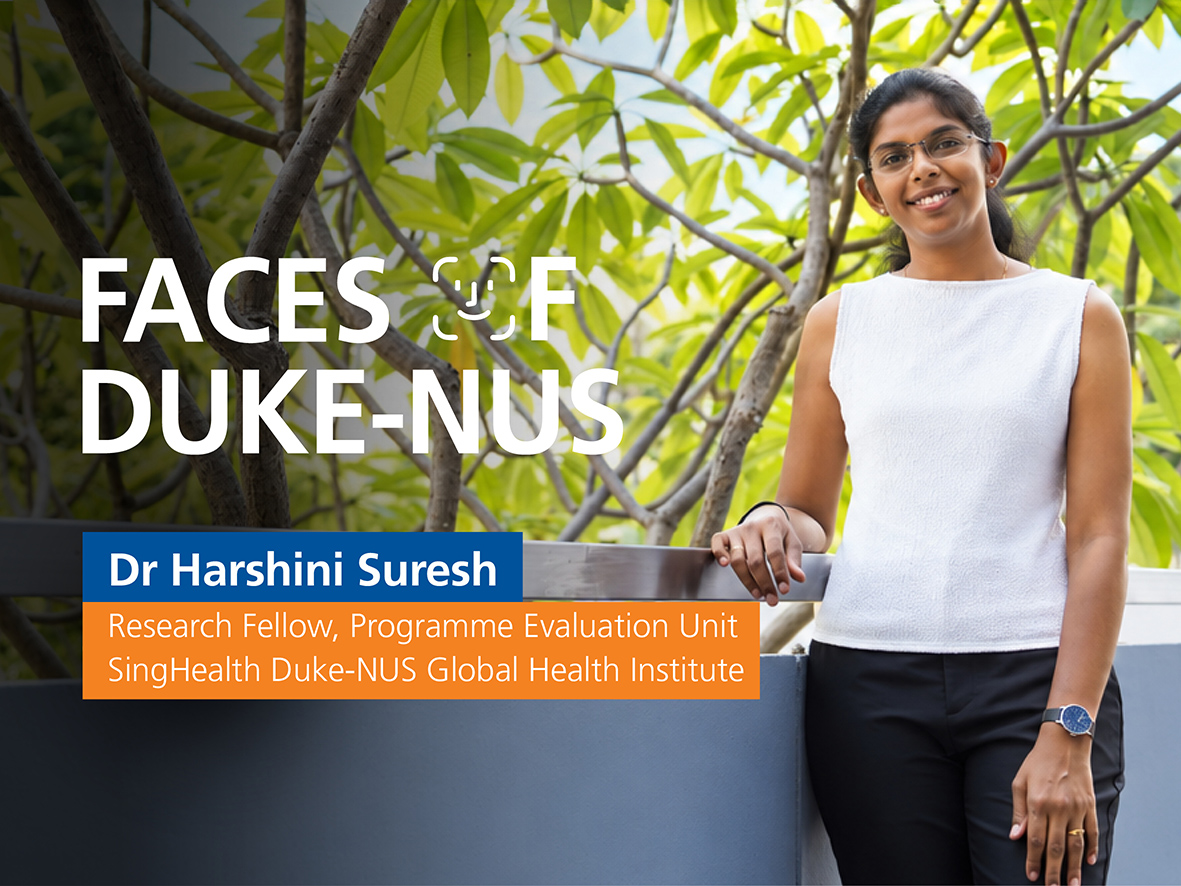
Late one night, while at home with her daughter, Sritha, Dr Harshini Suresh’s phone pinged with unexpected news.
Months earlier, the National Research Foundation Singapore had nominated her to attend the 75th Lindau Nobel Laureate Meeting, a rare opportunity that brought together 600 young scientists from around the world. For a moment, she wasn't sure she'd read the message correctly. She had been selected.
The excitement was quickly followed by worry. Attending the meeting would mean leaving Sritha at home. But with her husband’s encouragement and support, Harshini went to Lindau, where conversations with Nobel Laureates and fellow scientists would shape how she thought about effort, outcomes and the long arc of research.
As a Research Fellow with the Programme Evaluation Unit at the SingHealth Duke-NUS Global Health Institute (SDGHI), Harshini studies what it takes for healthcare interventions to work in practice, and for the people they are meant to help. Her work sits at the intersection of clinical medicine, public health and health systems research, asking not only whether an intervention works, but for whom, why and under what real-world conditions.
In this edition of Faces of Duke-NUS, Harshini shares why listening is central to her research, how working within the SDGHI shapes her work, and advice from a Nobel Laureate that has stayed with her both at work and at home.
Could you tell us about your work at SDGHI?
My work uses implementation science to evaluate clinical trials and healthcare programmes in hospitals and health systems. In simple terms, we ask whether a programme works, for whom, and why.
A promising intervention is only meaningful if it can be put into practice. By studying these interventions during the trial phase, we can understand what helps or hinders uptake, whether the intervention can be sustained and whether it could work across different hospitals or healthcare settings.
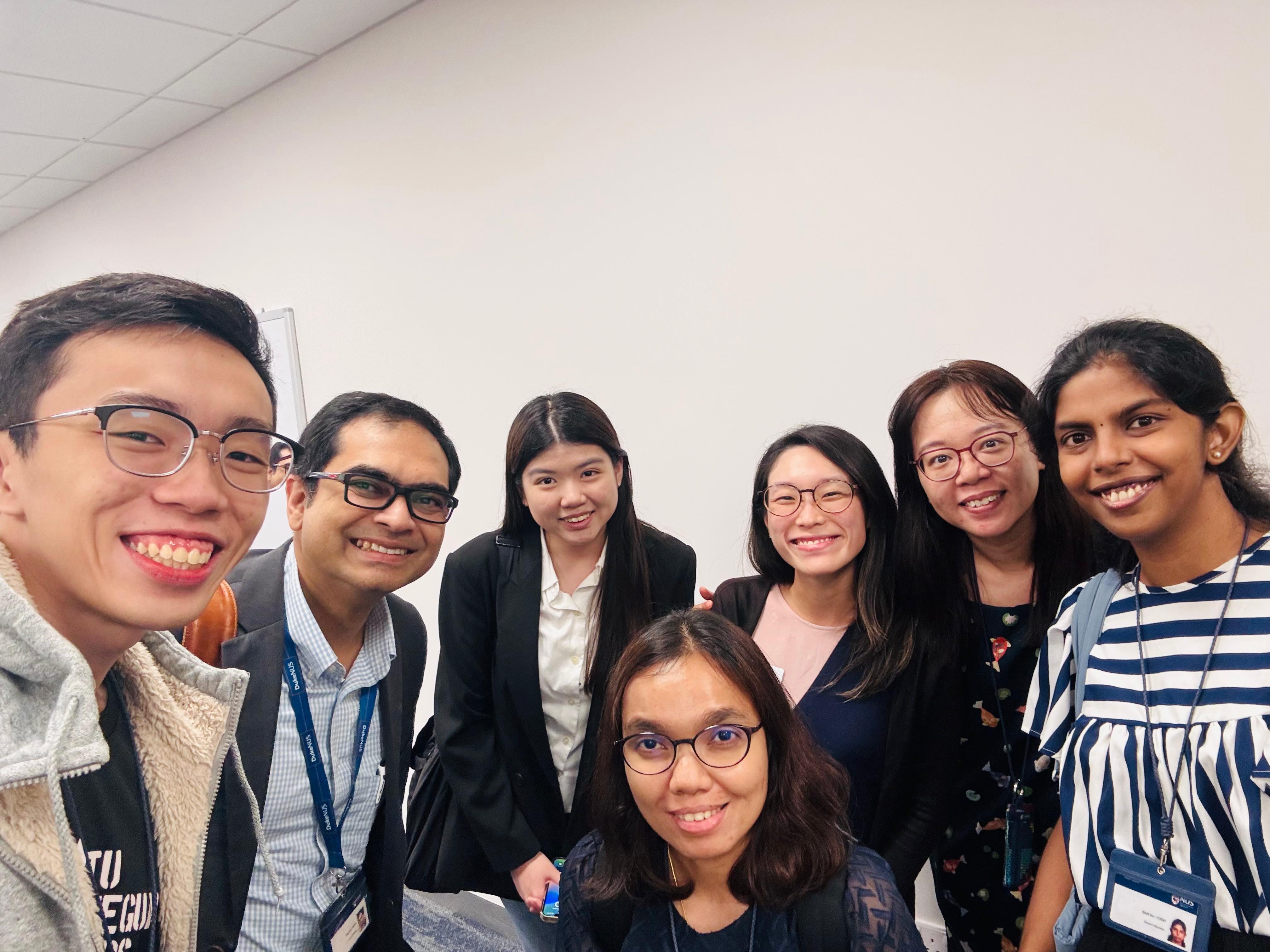
Harshini (right most) with colleagues from SDGHI’s Programme Evaluation Unit and their research collaborators. // Photo credit: Harshini Suresh
How does working within an institute like SDGHI influence the direction of your research?
Duke-NUS produces research that is meant to improve health, not simply be published. My work sits at the last stretch of that journey.
The SingHealth Duke-NUS Academic Medical Centre allows me to carry out implementation research on initiatives like Singapore’s pilot lung cancer screening programme, tools to measure respectful maternity care and workforce planning in polyclinics. This may not be discovery science, but it helps determine whether advances can reach patients in real-world settings.
There is also an important regional dimension. Many healthcare interventions used in Asia were first tested in health systems very different from ours. Being based in Singapore gives us an opportunity to build evidence about what works in our own settings and contribute insights that may be useful elsewhere in the region.
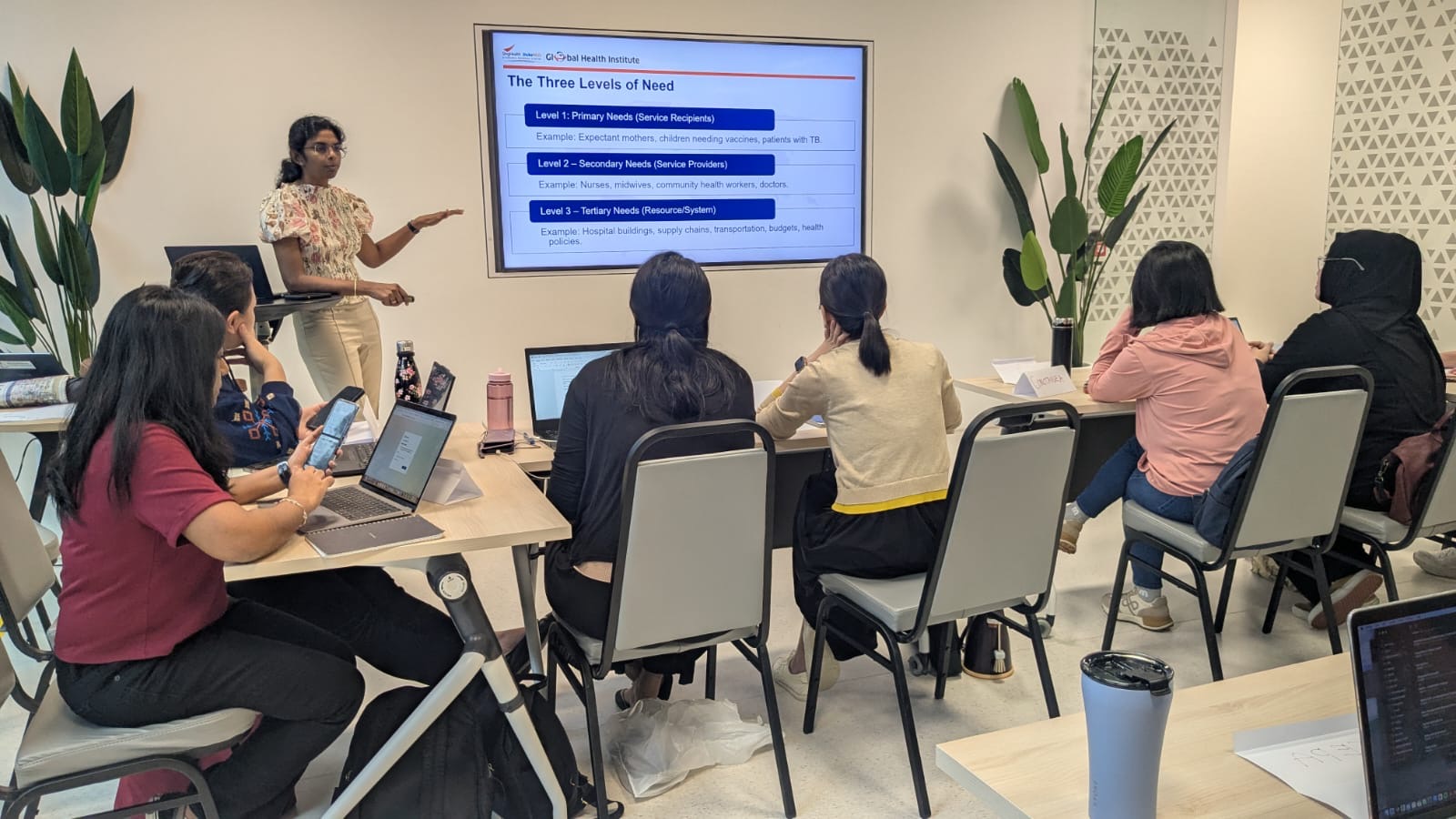
What does a typical workday for you look like?
The work we do is seasonal. There are months where we focus on grant applications, especially ahead of the National Medical Research Council grant application deadline. Other months are spent focusing on data collection and data analysis. I especially love data collection, because I get the opportunity to talk directly to people at different hospitals.
What do you find most fulfilling or satisfying about your work?
In previous research projects that I have worked on, such as maternity care, elderly care and workforce planning, I was able to focus on the research question from both the healthcare provider as well as the patient perspectives.
For example, in a health workforce planning project, I was able to build rapport with doctors who gradually felt comfortable sharing their experiences and the pressures they faced. My research may not change their day-to-day work immediately, but I hope that having someone listen and take their concerns seriously makes a difference.
Although I am naturally a quiet person who takes time to open up, that barrier disappears when I speak with patients and doctors. Being able to connect with them makes the work so rewarding and that is why I value talking directly to them.
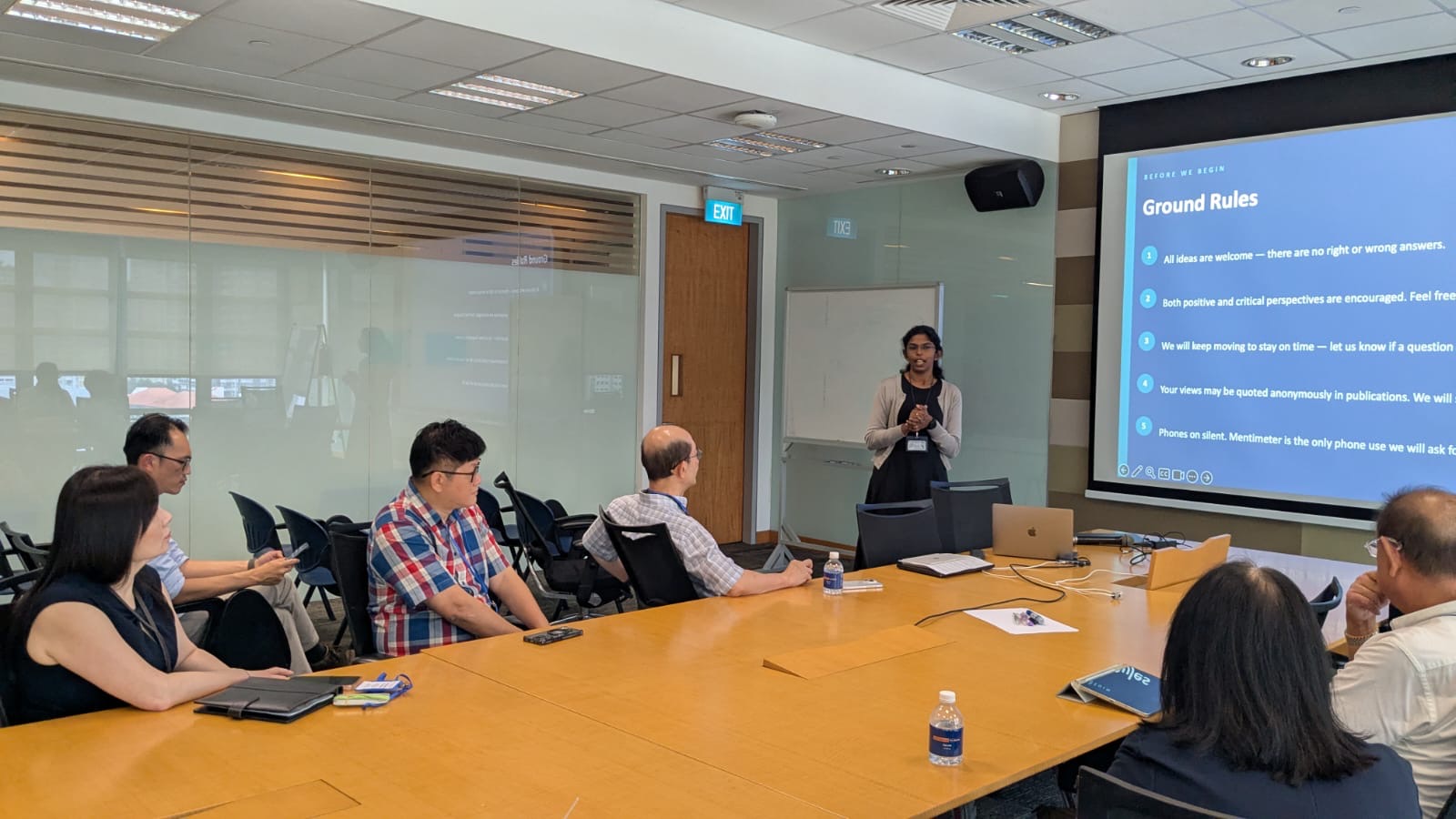
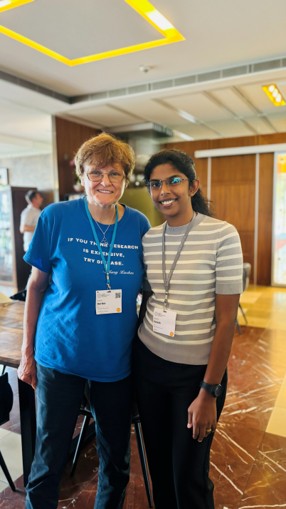
Katalin Karikó shared a nugget of wisdom that transformed Harshini’s perspective on effort and outcome at work and at home // Photo credit: Harshini Suresh
What has been a highlight of your career so far?
One of the most memorable moments was a Laureate Lunch with Katalin Karikó, whose pioneering work on messenger RNA (mRNA) lay the foundation for COVID-19 vaccines.
I asked her how early-career researchers could handle stress. Her answer surprised me. She said everyone, including Nobel Laureates, feels stress. The point is not to get rid of it. What matters is to “focus on the work that is yours to do and stop trying to control the outcome”.
That advice carried weight because of her own story. She had spent years pursuing research whose impact was not immediately recognised, but she continued anyway.
That changed how I view my own work. Implementation research is slow and often takes years before change becomes visible. I used to find that discouraging. I now try to recognise the value of doing the work carefully and consistently, even when progress is not immediately apparent.
It applies to being a parent too. There is no outcome to optimise. There is only whether I am emotionally and mentally present with my daughter, or whether my mind is somewhere else.
How has parenthood influenced your work?
The work itself did not change. I was already working on respectful maternity care before I became a mother, looking at whether women are informed, consulted and treated with dignity during childbirth. But at the time, I understood it primarily as a research question.
After having Sritha, I saw it through a different lens. It is hard to treat this field as a purely academic measurement problem once you have been on the other side of it.
My husband, my parents and my in-laws have carried an enormous amount over the last two years, and whatever I have managed professionally in that time belongs partly to them.
What advice would you give someone considering a similar path?
Ask the unglamorous question. The competitive, well-funded questions often attract plenty of attention. But the question of why an intervention or programme is not reaching people can be just as important, and it deserves more focus.
And do not wait until you feel completely qualified to move into a new field. I went from clinical medicine to public health and then to health systems research, including in a country I had never worked in before. At every step, I was learning as I went. Sometimes the best way to grow is to begin.
What might colleagues be surprised to learn about you?
I love cars, and I love driving. Not as a mode of transport, but the act of driving itself. It quiets my mind. I have wanted a Mini Cooper for years. Not yet, but someday.
What are you currently reading?
The Mountain Is You by Brianna Wiest. I have been reading a lot of self-help lately.
What is your favourite place to recharge?
My own desk on campus. It’s where the day feels like it’s mine to organise.
Do you have a personal motto that motivates you?
Do your work honestly and give it time. The right things tend to happen when they are meant to.
What helps you unwind?
On weekends, we go to the Mandai wildlife parks. Sritha loves imitating the animals. Watching a toddler imitate a penguin is more restorative than it sounds.
Now two years old, Sritha’s favourite game is imitating Harshini. Watching the toddler mirror gestures and moods she has not noticed about herself is, Harshini says, “an efficient way of seeing your own life clearly” // Photo credit: Harshini Suresh
All photos in this story are copyrighted by Harshini Suresh and Duke-NUS.
We’re always on the lookout for stories to tell. Know a colleague we should feature in a future Faces of Duke-NUS spotlight? Drop us a note at communications@duke-nus.edu.sg!