When a fighter jet crashed into Milestone High School in Dhaka this July, it triggered one of the most devastating mass casualty incidents Bangladesh has seen in recent years. Within hours, over 50 young students and teachers, most suffering severe burns and inhalational injuries were rushed to the National Institute of Burn and Plastic Surgery (NIBPS).
Among the first international responders on the ground was a multidisciplinary medical team from SingHealth, answering a call for help from long-time partners at NIBPS and the Ministry of Health and Family Welfare.
But this was not a new relationship; it was the continuation of a journey that began nearly a decade ago.
A partnership built over years
Since 2017, under the Temasek Foundation–supported Capacity Enhancement for Burn Specialists in Bangladesh programme, SingHealth has worked closely with the Sheikh Hasina National Institute of Burn and Plastic Surgery (SHNIBPS) to train more than 300 Bangladeshi doctors, nurses, and allied health professionals, cascading knowledge to over 1,000 healthcare workers across the country.
Together, the partners established new treatment protocols, rehabilitation frameworks, and a national skin bank; the first of its kind in Bangladesh to improve the survival and recovery of burn victims.
That collaboration laid critical groundwork for the response to the milestone tragedy in 2025.
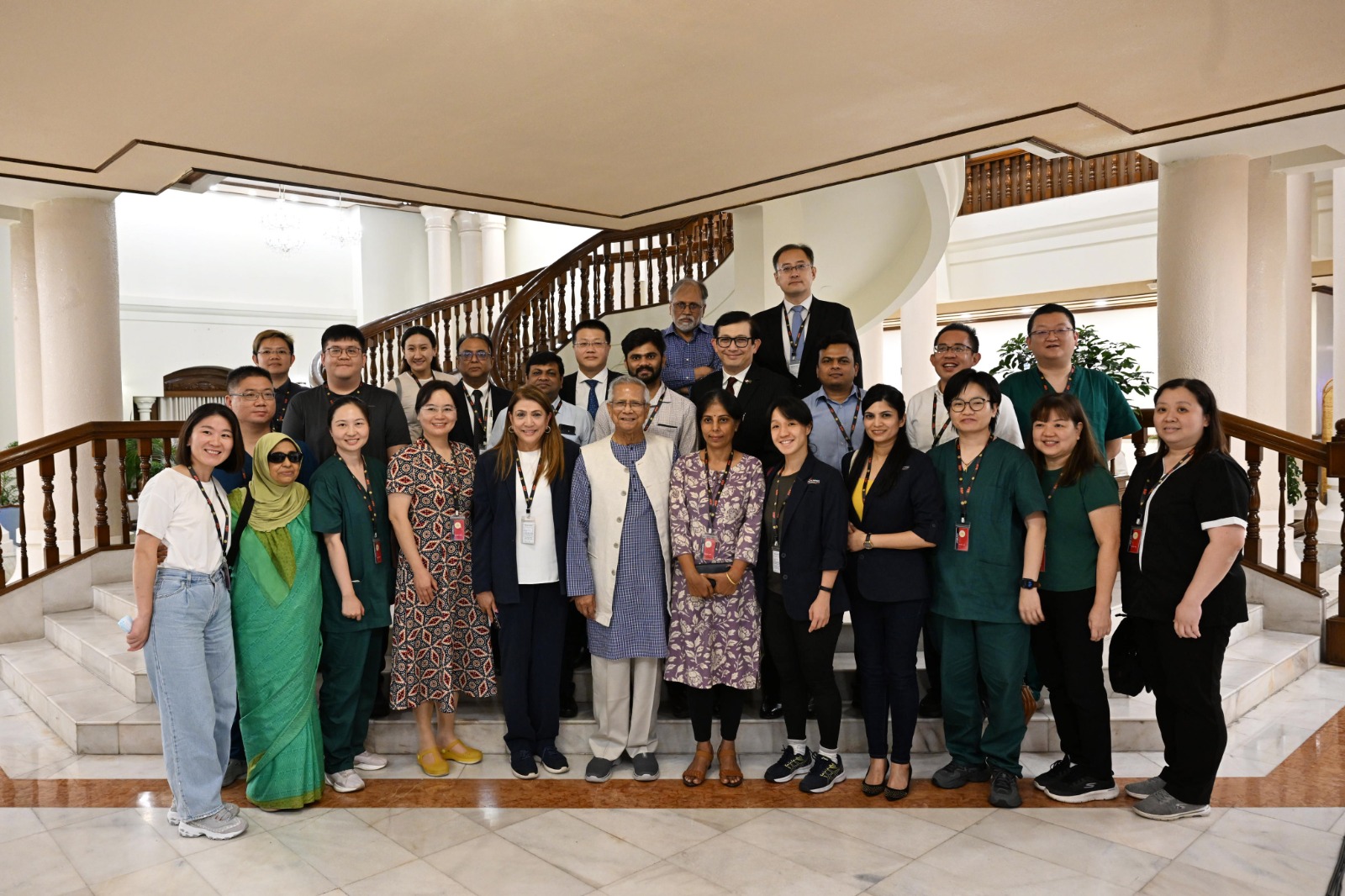
SingHealth team with Chief Advisor of Bangladesh’s interim government - Prof Mohammed Yunus among other teams
Swift action, shared purpose
Within 24 hours of the crash, SingHealth dispatched a specialist team led by A/Prof Chong Si Jack, Dr Irene Wong, Dr Jolin Wong, and Nurse Clinician Chester Chow, working alongside Bangladeshi and Chinese colleagues to manage the crisis.
The team helped to:
- Establish a command and control system to coordinate care;
- Perform 28 life-saving surgeries;
- Support ICU management of critical patients;
- Introduce Bangladesh’s first successful prone positioning for severe ARDS;
- Set up an Infection Control Task Force to prevent cross-contamination and sepsis; and
- Ensure zero ICU deaths at handover on 31 July.
Their hands-on mentorship, daily ward rounds, and infection control protocols helped stabilise care, while morale was kept high through shared meals and quiet acts of camaraderie.
As Singapore’s Prime Minister Lawrence Wong noted, the mission reflected “the spirit of friendship and solidarity between Singapore and Bangladesh.”
Healing beyond borders
For SingHealth’s burns and critical care teams, the mission in Dhaka was both a test and a testament. It proved that the years invested in partnership, training, and trust had built something enduring; a network of shared knowledge that could be mobilised in moments of crisis.
As one of the team leads reflected:
“When we saw our Bangladeshi colleagues apply what they’d learnt years ago, protocols we’d developed together. It was deeply moving. This wasn’t just about emergency responses. It was about capacity, confidence, and compassion coming full circle.”
Looking ahead, both SingHealth and NIBPS are working towards strengthening intensive care, infection control, and emergency preparedness, ensuring that the systems built today will continue to save lives tomorrow.