EU-funded project will help countries build early-warning systems to spot infectious disease threats before clinical cases surge
SINGAPORE, 9 June 2026 – Duke-NUS Medical School has secured a €2 million EU grant to help countries across Asia strengthen their ability to detect infectious disease threats early, using wastewater and environmental surveillance as a population-level early warning system.
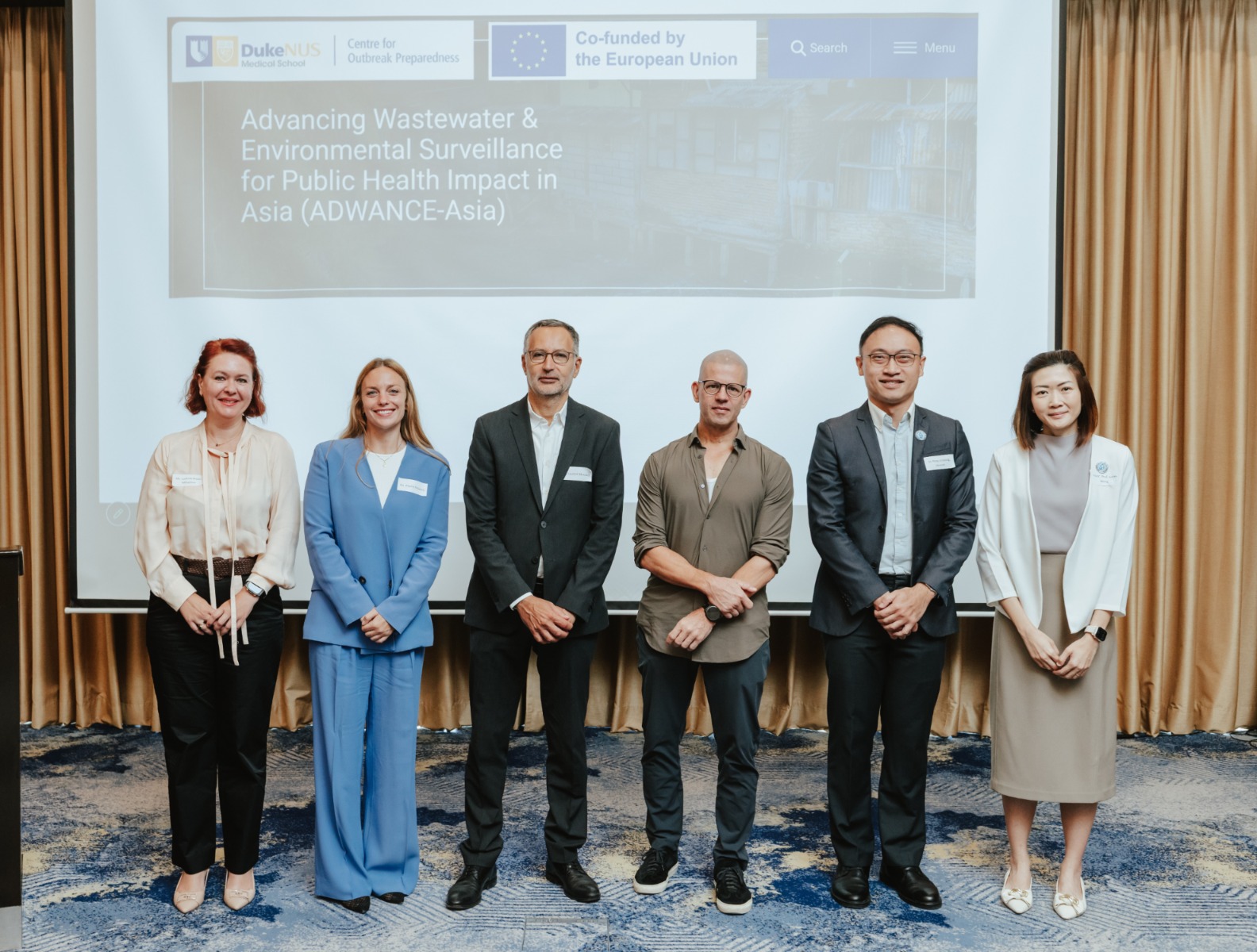
At ADWANCE-Asia kick-off meeting on June 8 in Kuala Lumpur, from left: Ms. Ludmila Nistor-Mihajlova, Policy Officer, Health and Digital Executive Agency (HaDEA), European Commission (EC); Ms. Angela Tessarolo, Policy Officer, Health Emergency Preparedness and Response Authority (HERA), EC; Mr. Laurent Muschel, Director, HERA, EC; Prof. Paul Pronyk, Director, Duke-NUS Centre for Outbreak Preparedness (COP), Dr. Vincent Pang, Assistant Professor, Duke-NUS COP; Dr. Judith Wong, Deputy Lead (Environmental Transmission), PREPARE, Singapore
The three-year project, ADWANCE-Asia or Advancing Wastewater & Environmental Surveillance for Public Health Impact in Asia, will be led by the Duke-NUS Centre for Outbreak Preparedness and will support countries in the region, particularly low- and middle-income countries (LMICs), in building sustainable wastewater and environmental surveillance (WES) systems that can pick up emerging threats before they are seen through conventional clinical reporting.
The project received funding under the European Union’s EU4Health programme call ‘Asia Pathogen Genomics Initiative (Asia PGI) to support wastewater surveillance for health threats’ early detection, managed by the European Health and Digital Executive Agency (HaDEA) on behalf of Health Emergency Preparedness and Response Authority (DG HERA).
Turning wastewater into an early warning system for outbreaks
Since the COVID-19 pandemic, wastewater surveillance has emerged as a promising and cost-effective approach to monitoring disease at the community level. Combined with advances in multi-pathogen genomic sequencing, including targeted next-generation sequencing (tNGS), WES can provide a timely snapshot of infectious threats circulating in a population. This is particularly valuable in resource-constrained settings, where clinical surveillance may be limited by under-testing, access gaps, or delayed reporting.
By strengthening wastewater surveillance as a regional early warning system, ADWANCE-Asia will enable public health authorities across the continent to detect emerging threats sooner and respond faster, therefore improving global pandemic preparedness.
The kick-off meeting of the project officially took place on 8-9 June 2026 in Kuala Lumpur, Malaysia, bringing together the European Commission, HADEA, the coordinators and regional partners to align on implementation priorities and plan the rollout of the project.
The ADWANCE-Asia project will focus on four areas:
Network collaboration: Strengthening the Asia Pathogen Genomics Initiative (Asia PGI) WES network to support regional coordination and cross-border information sharing.
Capacity building: Working through the Asia PGI Academy and with regional and global partners, the project will deliver structured training in standardised laboratory, genomics and bioinformatics workflows, while keeping partners abreast of the latest scientific advances in wastewater and environmental surveillance.
Capability development: Supporting LMICs to pilot and scale genomics-based surveillance across multiple infectious diseases within their national WES programmes, starting with vaccine-preventable diseases.
Strategic evidence and integration: Generating evidence and practical tools frameworks for national WES integration, including strategic planning frameworks, legal and ethical guidance, and mapping and integration of existing WES dashboards across Asia to strengthen evidence-driven public health decision-making.
Duke-NUS Centre for Outbreak Preparedness Assistant Professor Vincent Pang Junxiong, project lead for ADWANCE-Asia, said:
"This is about helping countries get ahead of outbreaks before they reach vulnerable populations. By detecting multiple pathogens from a single wastewater sample, this approach can give public health an earlier signal of what may be circulating in the community, potentially even before a surge in cases is reported, so that they can act faster and more effectively."
Opening the kick-off meeting, Laurent Muschel, Deputy Head of DG HERA, said:
“Strengthening early-warning systems through innovative approaches like wastewater surveillance is essential to improving preparedness across regions and response. Initiatives such as ADWANCE-Asia demonstrate the value of cross-border collaboration and scientific innovation in protecting public health and enhancing pandemic readiness. DG HERA has invested significantly to advance wastewater-based epidemiological surveillance (WES) on every continent. Through GLOWACON, we have helped build trust in this innovative approach and laid the foundations for its use as a truly global early-warning tool.”
EU acknowledgement
Co-funded by the European Union. Views and opinions expressed are however those of the author(s) only and do not necessarily reflect those of the European Union or European Health and Digital Executive Agency (HaDEA). Neither the European Union nor the granting authority can be held responsible for them.
Learn more about ADWANCE-Asia at
Advancing Wastewater & Environmental Surveillance for Public Health Impact in Asia (ADWANCE-Asia)
For media enquiries, please contact Duke-NUS Communications.