AI-driven tests jointly developed by Singapore Eye Research Institute (SERI) and Duke-NUS capture patients’ quality of life in minutes, helping doctors and researchers make faster, better-informed decisions.
SINGAPORE, 7 APRIL 2026—In eye clinics and clinical trials, doctors increasingly rely on patients’ own reports of how eye disease and treatment affect daily life. Yet these patient questionnaires are often long, repetitive and difficult to use in real-time care, limiting their value in both research and care improvement.
A spin-off from the Singapore Eye Research Institute (SERI) and Duke-NUS Medical School, PROMinsight is tackling this problem by using AI-driven, computerised adaptive tests (CATs) to measure patients’ quality of life quickly and precisely, turning lived experiences into data that clinicians and researchers can act on for better vision care. The core technology was developed by leveraging years of specialised ophthalmic research and data from SERI.
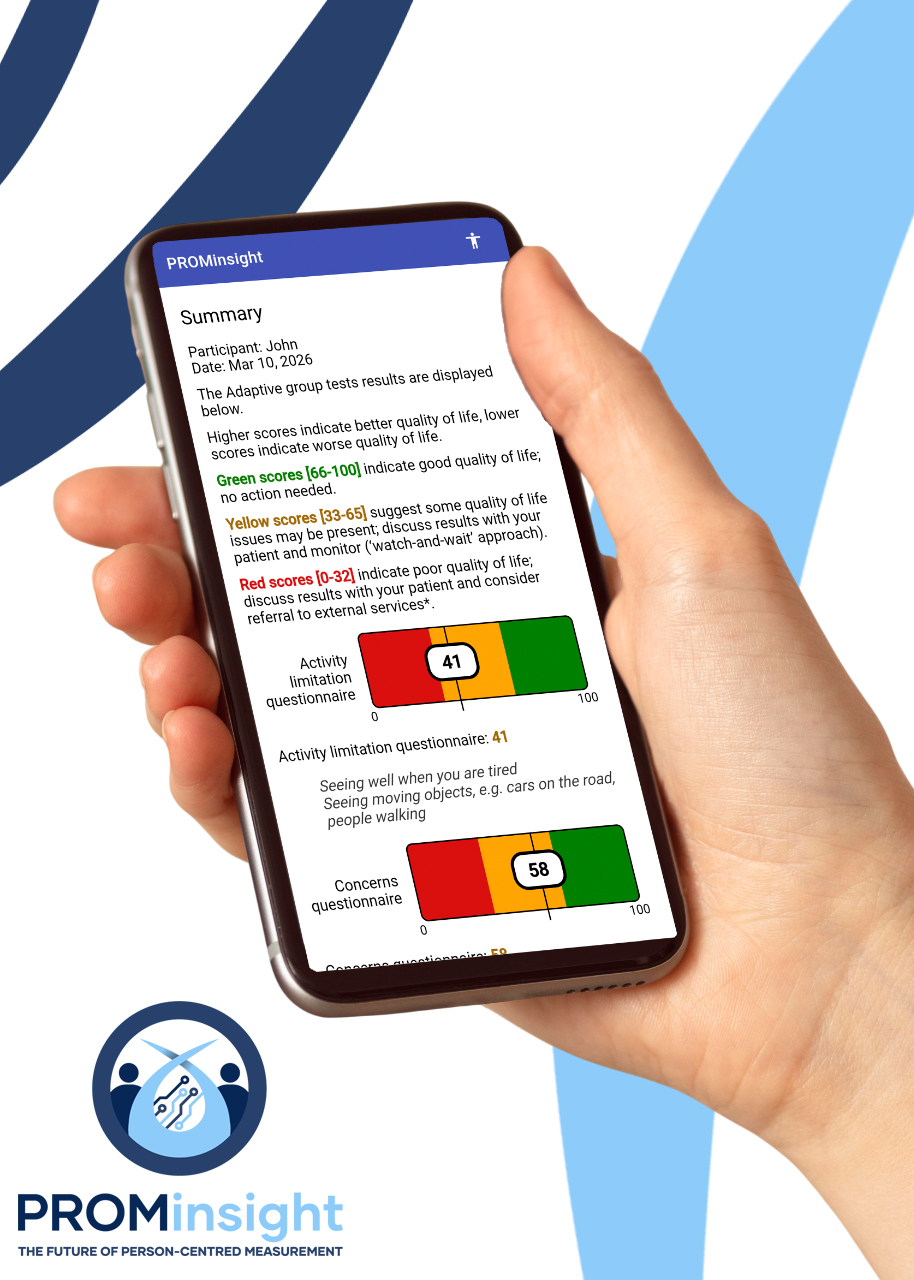
An illustration of PROMinsight’s AI-driven, computerised adaptive tests to measure patients’ quality of life, turning lived experiences into data that clinicians and researchers can act on for better vision care. // Image credit: PROMinsight
PROMinsight has licensed three CAT-based technologies from the SingHealth Duke-NUS Academic Medical Centre:
- MyoRI-CAT, for patients undergoing myopia interventions such as spectacles, contact lenses or laser procedures
- GlauCAT-Asian, for glaucoma patients in Asian clinical settings
- MacCAT, for patients with AMD.
With cloud-based delivery and real-time scoring, the CATs are designed to integrate into routine workflows, enabling clinicians to act on patient-reported insights during consultations.
In a one-year implementation study conducted at the Singapore National Eye Centre (SNEC) to test the feasibility and uptake of PROMinsight’s eye-related CATs in patients undergoing treatment for diabetic macular edema, glaucoma, and cataract, outcomes exceeded expectations.
The CATs were very well-received by patients with a high uptake rate of more than 80 per cent and patients reporting a very positive experience using the CATs. Discussions are on-going to roll this out soon across several departments in SNEC.
A retinal patient:
“The questionnaire asked about things my doctor doesn’t usually ask, like coping with daily vision problems. This is what is lacking right now in the current clinical situation.”
Doctors also found value in having the Quality of Life (QoL) scores available in SNEC’s electronic medical records to guide clinical management.
Prof Shamira Perera, Senior Glaucoma Consultant, Singapore National Eye Centre:
“One patient had good vision but poor QoL scores. Without CAT, I'd have assumed everything was fine and moved on.”
Associate Professor Christopher Laing, Vice-Dean for the Office of Innovation and Entrepreneurship at Duke-NUS and Co-Chair of the SingHealth Duke-NUS Academic Medicine Innovation Institute (AMII), said:
“PROMinsight shows what’s possible when clinicians, researchers and entrepreneurs come together and put patient care at the centre of their collaboration. By translating research into tools that clinicians can use immediately, we shorten the distance between discovery and better care.”
Dr Fang Xiaoqin, Director of Technology Development & Commercialization at the Singapore Eye Research Institute, added:
“This collaboration between Duke-NUS and SERI demonstrates how academic partnerships can accelerate innovation, turning research discoveries into practical tools for ophthalmologists and bringing better eye care to patients faster.”
Improving care through patient-centred measurement
PROMinsight is internationally recognised in the PROMs field, with collaborations spanning pharmaceutical and MedTech companies, ophthalmologists at tertiary eye centres worldwide, and organisations such as the International Consortium for Health Outcomes Measurement, the US Food and Drug Administration and the European Medicines Agency.
Most recently, PROMinsight received a significant non-dilutive investment from one of the world’s leading pharmaceutical companies specialising in ophthalmology. This provides strong support for the company’s plans to deploy these technologies across clinical trials and healthcare settings.
Dr Eva Fenwick, Co-Founder and Chief Executive Officer of PROMinsight, who’s also an Adjunct Associate Professor at Duke-NUS Medical School, said:
“Our CATs will support pharmaceutical companies and contract research organisations in capturing robust patient-reported data on the effectiveness of new therapies and devices. In clinical care, they will help eye clinics and hospitals monitor outcomes, support follow-up and advance value-based care initiatives.”
As healthcare systems place greater emphasis on outcomes that matter to patients, tools that can reliably capture lived experience at scale are becoming essential. PROMinsight’s work shows how patient-centred measurement can move from research into everyday clinical practice.
For media enquiries, please contact Duke-NUS Communications.