Autophagy, or “self-eating,” as it is translated from Greek, has garnered a lot of attention in the field of cell biology. It appears that eukaryotic cells have evolved a way to survive the condition of nutrient deprivation and sustain vital cellular functions by consuming the non-essential part of themselves.
This amazing machinery is well conserved in many organisms, from baking yeast to man, which supports its fundamental importance. In fact, the disruption of autophagy leads to multiple pathological conditions, such as cancer and neurodegeneration. The level of autophagy relies on a delicate balance; too much or too little autophagy has proved detrimental to cells. It is therefore fundamentally important to understand the regulation of pro-autophagic and anti-autophagic process, specifically in the context of health and disease.
A recent study, by PhD students Zhu Wanlong, Tong Honglian, and Teh Jing Tsong in Assistant Professor Mei Wang’s laboratory (Duke-NUS Cancer and Stem Cell Biology Programme), focusing on FoxO proteins, has shed new light on the regulation of autophagy. FoxO proteins are well investigated autophagy regulators. Previously, it was generally acknowledged that FoxO1 and FoxO3a stimulate autophagy, through their function in the nucleus as transcription factors. However, almost all studies have been done in non-cancerous cells. This new Duke-NUS led study investigated whether the FoxO proteins function similarly in cancer cells to promote autophagy. This research explores the new and complex functions of these important regulators, which may provide new opportunities for cancer therapy.
Dr. Wang’s team made several discoveries in the recently published paper. They showed that it is as a cytosolic, not nuclear protein, where FoxO1 works as a master coordinator in metabolism to positively regulate autophagy. Contrary to past studies, the work demonstrates that FoxO3a can also serve as a negative regulator of autophagy in some cancer cells, and it does so by suppressing the level of FoxO1. This revealed a previously unrecognised way that the sister proteins interact, and that the regulation of autophagy by FoxO1 / FoxO3a is not solely performed through the commonly recognised conduit of mTOR signaling. In addition, the study highlights the likelihood that FoxO3a regulation of autophagy is different in cancer cells compared to normal cells.
A major challenge in cancer therapy is to differentially kill cancerous cells while sparing the normal cells. Therefore, identifying the differences in regulation by FoxO3a between benign and cancer cells is significant. “As treatment usually involves inactivating a cancer promoting protein, the fact that suppression of the function of FoxO3a induces autophagy and inhibits cell proliferation, presents therapeutic opportunities,” explained Dr. Wang and her colleagues.
This work was published in the journal PLOS ONE, and was supported by funding from the Duke-NUS Signature Research Programme, with funding from the Singapore Ministry of Health.
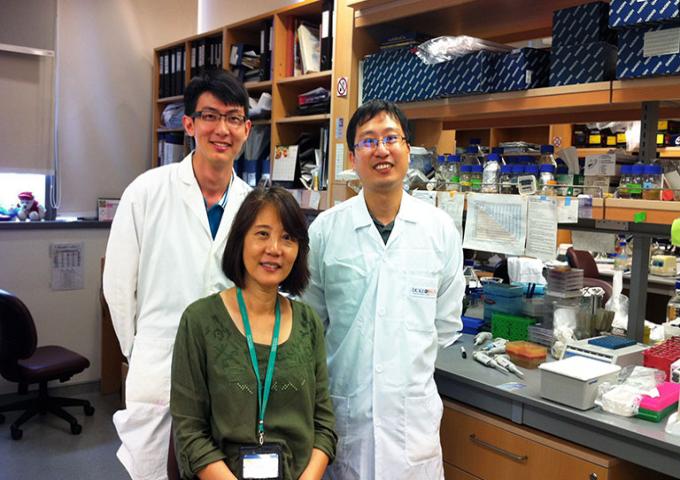
Photo: The authors of the study (L-R): Zhu Wanlong, Asst. Prof. Mei Wang-Casey and Teh Jing Tsong
This article first appeared in Vital Science (April 2015)