What does it mean to build a career that advances medicine, not just through clinical care, but through research, education and leadership?
At Duke-NUS, that question comes into sharp focus through the Hall of Master Academic Clinicians.
On 26 March, nine outstanding clinicians were inducted into this distinguished group, recognised for their contributions to advancing academic medicine across the SingHealth Duke-NUS Academic Medical Centre (AMC). The ceremony, held at the Ngee Ann Kongsi Auditorium, brought together over 100 faculty, leaders and partners to celebrate not only individual achievement, but the collective strength of an ecosystem designed to improve patient care.
.jpg?sfvrsn=81d7a693_0 "20260326 Master Academic Clinicians 2026 (3)")
The newly inducted Master Academic Clinicians share a group photo with SingHealth Group CEO Professor Ng Wai Hoe (left) and Dean Professor Patrick Tan (right).
Launched in 2021, the Hall recognises clinicians who exemplify excellence across clinical practice, education, research and innovation, as well as patient safety and quality improvement. More importantly, it highlights a model of academic medicine that Duke-NUS seeks to nurture, one that integrates these domains to drive meaningful and sustained impact.
This year’s sixth cohort represent between them five healthcare institutions—National Dental Centre Singapore (NDCS), National Heart Centre Singapore (NHCS), National Neuroscience Institute (NNI), KK Women’s and Children’s Hospital (KKH), Singapore Health Services and Singapore General Hospital (SGH).
In his opening address, Duke-NUS Dean Professor Patrick Tan described the event as an important tradition, underscoring its significance in highlighting the AMC’s collective mission that integrates clinical care, education, research and innovation.
.jpg?sfvrsn=9e9a651f_0 "20260326 Master Academic Clinicians 2026 (2)")
Prof Patrick Tan delivers the welcome address
This synergy, he noted, is what enables the AMC to act as a catalyst—bringing together ideas, disciplines and institutions in ways that move medicine forward.
Among those inducted into the Hall was Professor Ivy Ng, senior adviser to the SingHealth board and member of the Duke-NUS Governing Board.
Her leadership has been “instrumental in strengthening the partnership between SingHealth and Duke-NUS”, by bridging the AMC’s clinical and academic missions, remarked Prof Tan.
He also extended his gratitude to Professor Chan Choong Meng and Associate Professor Chow Wan Cheng, before addressing all the Master Academic Clinicians (MACs), adding: “Each of them reflects what it means to be a Master Academic Clinician—leaders who not only excel in their own fields, but who also invest deeply in mentoring others and strengthening the institutions around them.”
Recognising the contributions of academic chairs
In addition to celebrating the newly minted MACs, the event also honoured the contributions of two former Academic Chairs, Professors Loo Chian Min and Soh Chai Rick.
“Academic Clinical Programmes (ACPs) are one of the defining features of our AMC,” said Prof Tan.
Since the first ACP was established in 2011, the programmes have grown to include 15 clinical specialties—each providing a framework that brings clinicians, educators and researchers across institutions to facilitate cross-sharing of ideas and expertise.
“I want to thank them for their leadership and dedication in shaping these programmes,” said Prof Tan.
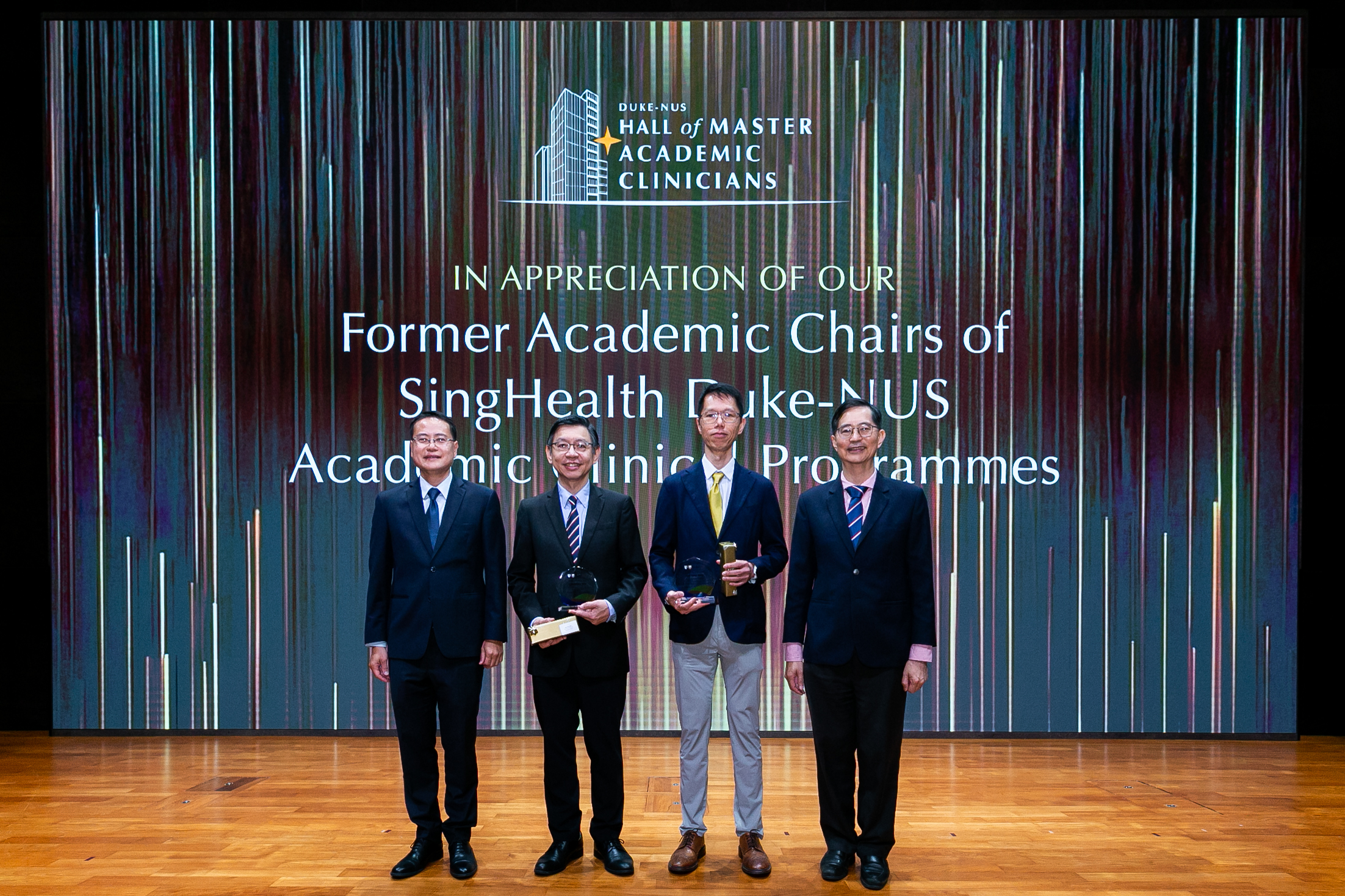
(From left to right): Prof Ng, with Professors Loo Chian Min and Soh Chai Rick, and Prof Tan.
Supporting faculty across different stages of their careers
Alongside these milestones, the event also recognised 14 faculty members who had achieved key milestones in their academic careers through promotion or appointment.
To provide clearer and more coordinated support for faculty, the Office of Faculty Affairs was established this year. “The Office will initially focus on faculty advancement processes before expanding its remit to support broader professional development initiatives,” said Prof Tan.
.jpg?sfvrsn=604b49c_0 "20260326 Master Academic Clinicians 2026 (4)")
The promoted and appointed senior faculty with Prof Tan (left) and Prof Ng (right) on stage.
The ceremony concluded with closing remarks from SingHealth Group CEO Professor Ng Wai Hoe, who described the MACs and promoted faculty as heroes, recognising their pivotal role in shaping the AMC.
“I believe our AMC will not be what it is today without heroes like every one of you,” he said. “Thank you for standing up to be counted, for truly being heroes of our SingHealth Duke-NUS AMC and helping us to define tomorrow’s medicine.”
.jpg?sfvrsn=e7e5044_0 "20260326 Master Academic Clinicians 2026 (1)")
In his closing remarks, SingHealth Group CEO Professor Ng Wai Hoe expressed his gratitude to the heroes at the AMC
It was, in many ways, more than a ceremony. It was a powerful reminder of what academic medicine can look like at its best where clinical excellence, research, education and leadership come together in service of patients and the system.
For students and younger faculty in the room, the day offered something equally important: a glimpse of what they themselves can become.
The Master Academic Clinicians are not just being recognised for what they have achieved, but for the kind of careers they represent: ones that are curious, collaborative, and committed to advancing medicine beyond individual practice.
As Prof Patrick Tan noted, it is this diversity of experience and perspectives-from pioneers who have shaped the system to emerging leaders who will take it forward-that defines the strengths of the AMC. It reflects a community that is open, globally engaged, deeply committed to improving healthcare in Singapore.
And in that sense, the celebration was not only about honouring today’s leaders, but about shaping tomorrow’s.
All photos in this story are copyrighted to Duke-NUS Medical School.