Scientific training should not stop at discovery. If graduate
biomedical education is to fulfil the promise of translational medicine, it must
prepare researchers to look beyond publications and grant funding and navigate
the long path from laboratory discovery to patient impact.
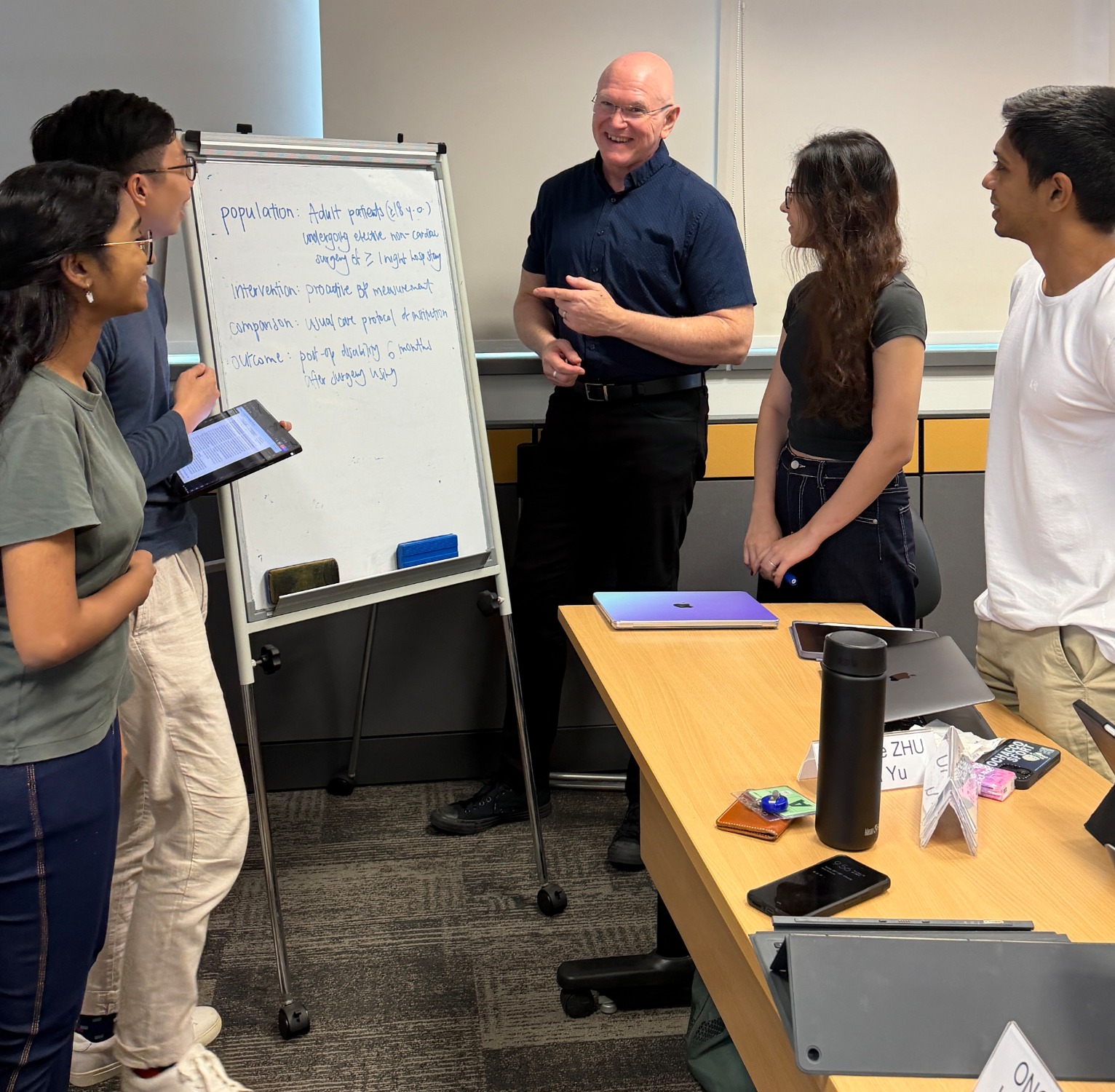 Compton (centre) is Senior Associate Dean (Medical Education) and Deputy Head in the Office of Education at Duke-NUS
That is the central argument of a new Nature Biotechnology Career Feature, “Educating for translation”, by Duke-NUS faculty members Professor Scott Compton and Professor Salvatore Albani, together with colleagues from the Eureka Institute for Translational Medicine.
Drawing on Eureka’s experience training a global network of scientists, clinicians and researchers, the authors call for a fundamental shift in graduate biomedical education. Rather than producing strong researchers alone, they argue that institutions must also cultivate translational scientists who can move promising ideas through complex systems and into real-world use.
At Duke-NUS, that philosophy is reflected across translational medicine, clinician-scientist training and innovation education. It is also central to the Master of International Translational Medicine (MITM) programme, which prepares learners to understand systems, stakeholders and professional competencies that shape the journey from idea to impact.
While Eureka has helped define an international educational ethos for translational medicine, the programme provides a Duke-NUS platform for putting that ethos into practice. Both recognise that biomedical leaders must be equipped to ask harder questions about their work: Who stands to benefit? What barriers could prevent a discovery from progressing? And what will it take to bring an idea into clinical practice?
For Prof Albani, this message is grounded in his experience as a
clinician-scientist working at the intersection of discovery, therapeutic
development and patient care.
 Albani is Professor at Duke-NUS Medical School and Director of the Translational Immunology Institute at SingHealth Duke-NUS Academic Medical Centre
“Translation does not happen simply because the science is strong,”
he said. “A discovery must pass through many hands, systems and decisions
before it can improve lives. Scientists need to understand that pathway and to
see themselves as responsible for helping knowledge move toward patients.”
Associate Professor Christopher Laing, Vice-Dean for Innovation
and Entrepreneurship at Duke-NUS, sees the same challenge from the perspective
of innovation and commercialisation and helps
researchers understand the process.
“Translational medicine includes more than science,” said Assoc
Prof Laing. “Researchers also need to understand how discoveries are developed,
commercialised and adopted so they can ultimately reach the people who need
them.”
This is often the kind of work Assoc Prof Laing supports at
Duke-NUS with faculty members and researchers who are already well into their
scientific careers.
"Translation does not happen simply because the science is strong. A discovery must pass through many hands, systems and decisions before it can improve lives."
Prof Salvatore Albani
The larger question, therefore, is whether such preparation should
begin earlier and be woven more deeply into biomedical training.
When learners encounter translational systems, stakeholder
perspectives, commercialisation pathways, and implementation challenges during
their formative training, they may be better prepared for the difficult journey
from discovery to patient impact.
For translational medicine to fulfil its promise, biomedical
education must prepare learners and scientists not only to make discoveries,
but also to carry them through complex systems and towards patients and communities
who stand to benefit.
About Scott Compton and Salvatore Albani
Professor Scott Compton is Senior
Associate Dean for Medical Education at Duke-NUS Medical School. He leads
strategic educational initiatives and the development of the School’s research-intensive
medical curriculum. He is also Programme Director and co-creator of the Master
of International Translational Medicine programme.
Professor Salvatore
Albani is an internationally recognised rheumatologist and immunologist,
a Professor at Duke-NUS Medical School and Director of the Translational
Immunology Institute at SingHealth Duke-NUS Academic Medical Centre. His research
focuses on understanding human immunity and translating scientific insights
info new diagnostic and therapeutic approaches.