Regulatory science rarely makes the spotlight. Often, regulation is imagined as a final gate between a scientific discovery and the patient. Both Professor Robert Califf and Professor John Lim discuss why this is the wrong place to start.
In this edition of In Conversation With, a former Commissioner of the US Food and Drug Administration and the Executive Director of the Centre of Regulatory Excellence at Duke-NUS Medical School discuss how science, regulation and clinical practice must work together if innovation is to reach patients safely and at scale. They also discuss why regulation is not simply a checkpoint, but part of the translational journey itself.
Professor Robert Califf is former Commissioner of the U.S. Food and Drug Administration and a physician-scientist and Duke faculty member with extensive experience in clinical trials, evidence generation, and health policy.
Professor John Lim is Executive Director of the Centre of Regulatory Excellence (CoRE) at Duke-NUS Medical School and former CEO of Singapore’s Health Sciences Authority. Across his distinguished career, he has helped shape Singapore’s regulatory development and continues to support training, capacity building, and thought leadership in the field.
From the lab bench to the clinic, and from health products to health services and professional oversight, both men describe a system made up of many moving parts. Their conversation traces how scientific discovery becomes clinical evidence, how evidence becomes practice, and how regulators help ensure that innovation does not outpace safety. Along the way, they reflect on Singapore’s evolving regulatory landscape and the role of institutions like Duke-NUS in preparing the next generation to think about translation earlier and more deliberately.
The discussion also turns to the pressures of a fast-changing future. AI, advanced therapies, and increasingly complex health systems are pushing regulators to be both rigorous and flexible. For both professors, the answer lies in stronger training, earlier engagement, and a shared understanding between scientists and regulators of what it takes to bring good ideas into real-world care.
MEDICUS: What is the hardest part of turning a discovery into standard care, and where can regulation help or slow that journey?
Califf: From development to market, from demonstrating a product’s effectiveness to implementing it in practice, all the pieces of the puzzle need to fit together. In the best of all worlds, a regulatory framework is intended to guide people who think they may have something to develop that provides a health benefit with generating the evidence needed to demonstrate that it is useful. Within an academic medical centre, one of the biggest challenges is that out of all the science being done, only a small fraction will translate directly into human health in the form of a product that can be used in the practice of medicine. The key is recognising and developing the ones that will make it through. That is hard work at every stage, because the studies often show that the biological effects of an intervention are different from the way you thought they would be. Even major breakthrough treatments can have surprising origins. The GLP-1 drugs, for example, were not developed for weight loss initially. They were developed for glucose control, and the clinical trials showed a much broader range of effects. It comes back to the puzzle: the pieces have to fit together.
Lim: The hardest part is that not everything that looks promising in research will actually translate into safe and effective health products. In my experience working in Singapore, we had to be realistic about how we could facilitate this. Even as a very small regulator, we still wanted to maintain world-class standards while ensuring timely access to safe, effective and quality therapeutics, so we had to build a system that was both effective and practical. That meant introducing ways to reference decisions made elsewhere, while also building our own capacity to evaluate products.
The key challenge in translation is recognising that a discovery is not yet a product. You still need the evidence, the right studies, and the right regulatory pathway. The regulatory framework helps support that journey by applying an evidence-based, risk versus benefit approach to make sure the product is truly safe, effective, and suitable for patients.
MEDICUS: Is there a gap between the science and regulation? If so, how can it be bridged earlier in training and research design?
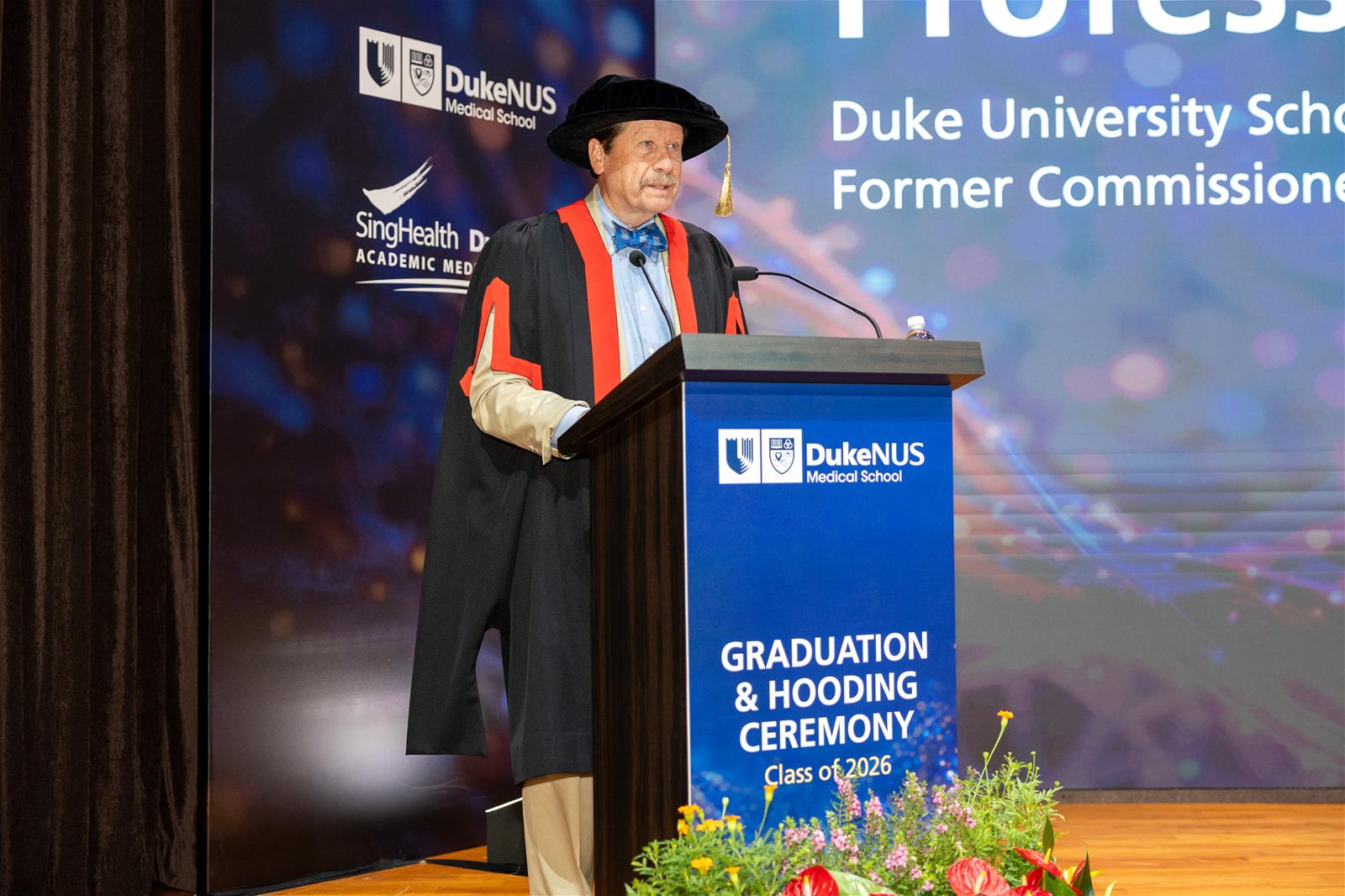 Prof Robert Califf delivering the keynote at the Duke-NUS Class of 2026 Graduation & Hooding Ceremony
Califf: Of course, it would be hard for me to say that regulation shouldn't be better understood. Science and healthcare and medical product regulation are complicated and always evolving, and they are driven by technologies as they evolve. The regulatory science of 20 years ago does not fit modern AI very well. But there is also a broader issue: scientists often do not think about the regulatory process early enough. A great scientist is not necessarily someone who is well equipped to think through how to develop a reliable product that can be used safely at scale. Scientists who understand the need for quality as part of the regulatory system will make fewer mistakes when they think their discovery might lead to a product that produces a health benefit.
Lim: More emphasis needs to be given to exposing students—whether they are biomedical engineers, medical students, or any health or biomedical professional—to the fact that regulation is important. This becomes especially important in clinical trial design.
If you go straight into collecting data, you may later find a big divergence between what you have and what regulators need. The problem is made more complicated because regulation is not fully harmonised. It can be difficult when people are trying to register products in different countries, because there are still country-specific questions to answer.
CoRE continues to support this system as an academic centre, through horizon scanning, training, capacity building, and think-tank work.
MEDICUS: How can institutions like Duke-NUS help students and researchers better understand the translational pathway, including the role of regulation?
Califf: I think universities are an important part of this, and that is why programmes like what you have here matter. But another important dimension is translational medicine more broadly, beyond the regulatory scheme. Having clinicians who understand how to do clinical research is really important. The skills that make you a good basic scientist don't necessarily make you a good clinical investigator. You need all those different components, and you need a governance system where everyone is valued and has something to contribute.
Lim: This is something we have not really pursued enough in the medical curriculum. I think you don't need a full course on this, but perhaps it needs to be highlighted somewhere to students, to give them some exposure, especially those training as clinician-scientists, so they are aware of regulation early on.
And it's interesting that Rob has mentioned this because we tend to begin to raise this when we're talking to PIs or people in research, but not really more upstream as they're still being trained. We wait till they graduate first and go into research and development and then we start injecting bits and pieces of information on regulation. It is appropriate not to overburden medical students but something more can be said at an earlier stage so they're aware of it down the road.
MEDICUS: AI is moving fast in healthcare. Why do existing regulatory frameworks struggle to keep up, and what should a more workable approach look like?
Califf: The regulation of science and of healthcare is complicated and always evolving. The regulatory science 20 years ago applied to modern AI doesn't fit well. That's why regulatory science is needed to inform new strategies. For the public, as a general rule, more knowledge is always better, yes, but most people have limited bandwidth for these issues. Still, understanding science and evidence, and understanding what it takes to make a scientific discovery into a product that is safe and reliable, is very important. Ideally, a healthy discussion should be occurring across the science, clinical care, policy and political ecosystem to devise regulatory systems for AI that enables ethical innovation.
Lim: It’s true that the existing frameworks are still quite nascent, and the traditional regulatory approach we have through software as a medical device is not adequate for the kind of AI and large language models of today. Across the world, different approaches are being used. For example, Singapore has generally taken a principles-based governance approach, with guidelines rather than very heavy legislation, because things are moving so fast.
I think players are beginning to realise we probably need to have hybrid frameworks deploying principles-based approaches, guidelines and harder legislation. But governments are all still working through what the right balance should be. The stakeholders need to keep coming together to think through and discuss this, which is why our Centre is committed to convening roundtables and experts to keep looking at the regulation of AI in health. It's very important that the conversation is ongoing.
MEDICUS: How can regulators stay rigorous while still leaving room for innovation, especially in fast-moving areas like AI and advanced therapies?
Califf: You never get it 100% right. It's always a work in progress. The FDA, for example, is always either too slow or too fast, depending on who you ask. So it's a matter of finding just the right balance for the time and the topic. For common diseases where we already have effective treatments, you would want a very high evidentiary standard. But for a rare disease that is uniformly lethal in children with no effective available treatment, for example, we have an entirely different standard that accepts a lot more uncertainty, because if you waited to have all the evidence you needed, you would go multiple generations of children dying. So the right regulatory approach depends on the context. In fast-moving areas, the science, the uncertainties, and the evidence all have to be considered together.
So there's going to be a need for some different regulatory scheme for AI, but we don't know what it should be yet. If one looks at FDA history, the best regulation occurs after some experience is gained to find that appropriate middle ground that enables innovation and reduces the probability of causing harm.
Lim: Regulatory professionals need to be knowledgeable. If they are not up to speed on the new scientific developments, they tend then to be overly cautious. Companies end up facing a lot of questions, which are often country-specific, making it very difficult for them to keep compiling different dossiers. The process becomes very expensive and slow, and in some cases, companies may not even submit products to certain countries.
One of the underlying philosophies of CoRE is to train regulatory professionals, whether they are national regulators or regulatory professionals in industry.
A related issue is to have more of a co-creation mindset. Enlightened regulators must have that approach, especially when talking of new or developing areas like AI. There needs to be more coming together of regulators and innovators to discuss what's required upstream so that innovation is not stifled, but then to also ensure that relevant concerns are addressed so that regulators can effectively fulfill their role of protecting the public.
MEDICUS: What has kept each of you committed to this field, and was there a defining experience that shaped your outlook?
Califf: It was never really my goal to be a regulator. I was a clinical doctor and a clinical investigator doing trials, and that led to a lot of interaction with the FDA and the EMA. Over time, it just evolved. I had to testify before advisory committees, then I was asked to serve on one, then I spent a year as an FDA employee, and eventually I was asked to be commissioner.
If you love evaluating evidence as a discipline, the FDA is the ultimate place to do that. The concept that you are setting policy for millions of people is exciting. It carries risk. You don’t want to make a bad decision. But not many people in life get a chance to have that sort of influence. And personally, that is very exciting.
 Prof John Lim at the 2024 CoRE Scientific Conference // Credit: Courtesy of CoRE
And when you're a commissioner, every day you get these briefings of everything that's known about a topic. And to me, that is just the ultimate fun, regardless of the decision. Just seeing everything that's known about a topic from really smart people that have put the information together, that's a great thrill.
Lim: Years ago when I was at HSA, my chairman was Professor Edison Liu, and we wrote a thought piece for The Straits Times, and I remember he put in this sentence where he said that to most people, regulation is as exciting as watching grass grow. From that opening statement, the entire article built the case that regulation is not only necessary, but also very interesting and exciting.
Regulation is not a necessary evil, but it's actually necessary in itself. And if done well, if we train regulatory professionals to be open-minded and agile, a lot can happen in supporting the whole R&D environment and opening doors for new discoveries that will ultimately help our patients and our populations while keeping them safe.
What has kept me going is seeing how a small system like Singapore’s could become world-class through a very pragmatic approach. I also find it gratifying that CoRE can continue to support that evolution and help Singapore’s system develop further.
MEDICUS: For students interested in healthcare policy or regulatory science, what advice would you give them?
Califf: In the area of policy and regulation, there's maybe two basic routes. One is for the person who's not going to be trained or educated in a biomedical science or clinical discipline. There are people who go to a school of policy, for instance.
But for those who are at a place like Duke-NUS, I would say the number one thing is to be really good in your discipline first. I think regulators are much better if they really understand the medical discipline that they came from. If you then decide you want to move towards policy, you will have a base of knowledge and understanding of a discipline, allowing you to contribute in a way that others can't.
Lim: I do not think we should expect students to train to become regulators, because only a small percentage will ever go into that field. But they should keep in mind that if they want their discoveries to reach patients, there will eventually be a regulator somewhere in the world who has to look at it. So they should have that awareness from the start. You do not need to overload students, but a basic understanding of regulation is important. And if they later want more specialised training, then there are programmes for that, like what CoRE offers.