Past Issues

Go
About the masthead: From the cover of MEDICUS’ first print issue — read more here

Seeing in a new light: How Duke-NUS embeds innovation in its medical education

A narrative on culture, courage and the revolution of innovation in medicine in Singapore’s only graduate-entry medical school. 

By Daryl Li and Anirudh Sharma (with additional reporting by Dr Chua Li Min)

Every journey of innovation begins with a small human moment—the kind that shifts something inside you. For final-year medical student Charles Yau, that moment arrived in a paediatric clinic, watching a child put on contact lenses calmly for the first time. He had expected resistance.  Instead, he saw relief, curiosity and even joy.

For months, Yau and his teammates in the Duke-NUS Health Innovator Programme (D-HIP)—students from across Medicine, Engineering and Business—had been developing a new contact lens management system to help children with myopia. Parents often spend up to an hour persuading their child to put them on each morning. This device changed that.

Seeing the child’s reaction, Yau realised something profoundly simple: innovation is not abstract. It is deeply human, grounded in small shifts that make someone’s life easier, safer or more dignified.  and it changes real lives in quiet, powerful ways. And it often begins with a willingness to see a familiar problem in a new light.

Duke-NUS Medical School’s own innovation story begins there—with the courage to look again.


Building innovators by design

Innovation at Duke-NUS is not left to chance. It is embedded deliberately into the School’s medical education curriculum, shaped through a partnership between the Office of Education and the Office of Innovation and Entrepreneurship (OIE). Together, they design an environment that equips students with the mindset, habits and skills needed to become future clinician-innovators.

“We teach every student to recognise unmet needs and develop ideas—and approaches—that can genuinely change patient care. That mindset is not an elective; it is core to how we train future clinicians.”

Prof Scott Compton

Duke-NUS’ medical students come from diverse undergraduate backgrounds—engineering, the life sciences, social sciences, computer science, law and more. They bring unique perspectives to their medical training, viewing problems through different lenses. This diversity is itself catalytic. But individual perspectives alone are not enough. What turns instinct into capability is the educational environment surrounding them.

This culture embraces a broad definition of innovation. It may take the form of a medical device or a new vaccine. It may drive improvements in patient outcomes, streamline clinical workflow, strengthen patient adherence, or entirely reshape the way medical knowledge is learned and applied. Across the School, innovation is understood as the bridge between imagination and eventual patient benefit.

Championing this effort is Associate Professor Christopher Laing, Vice-Dean of Innovation and Entrepreneurship, who brings together the School’s people, programmes and partnerships into a coherent approach. As he puts it, Duke-NUS’ approach is to “build an innovation community—if you concentrate on people, the projects will follow”. His philosophy is simple: start with good people. Working closely with Associate Professor Shiva Sarraf-Yazdi, Vice-Dean of Education, the School has made innovation “a core component of its mission for medical education”. Their collaboration ensures that innovation is not an add-on, but an integral part of how Duke-NUS prepares future clinicians.


What makes a future clinician-innovator?

Even with their diverse academic backgrounds, Duke-NUS’ medical students share a common purpose—tackling challenges that affect patients’ lives.
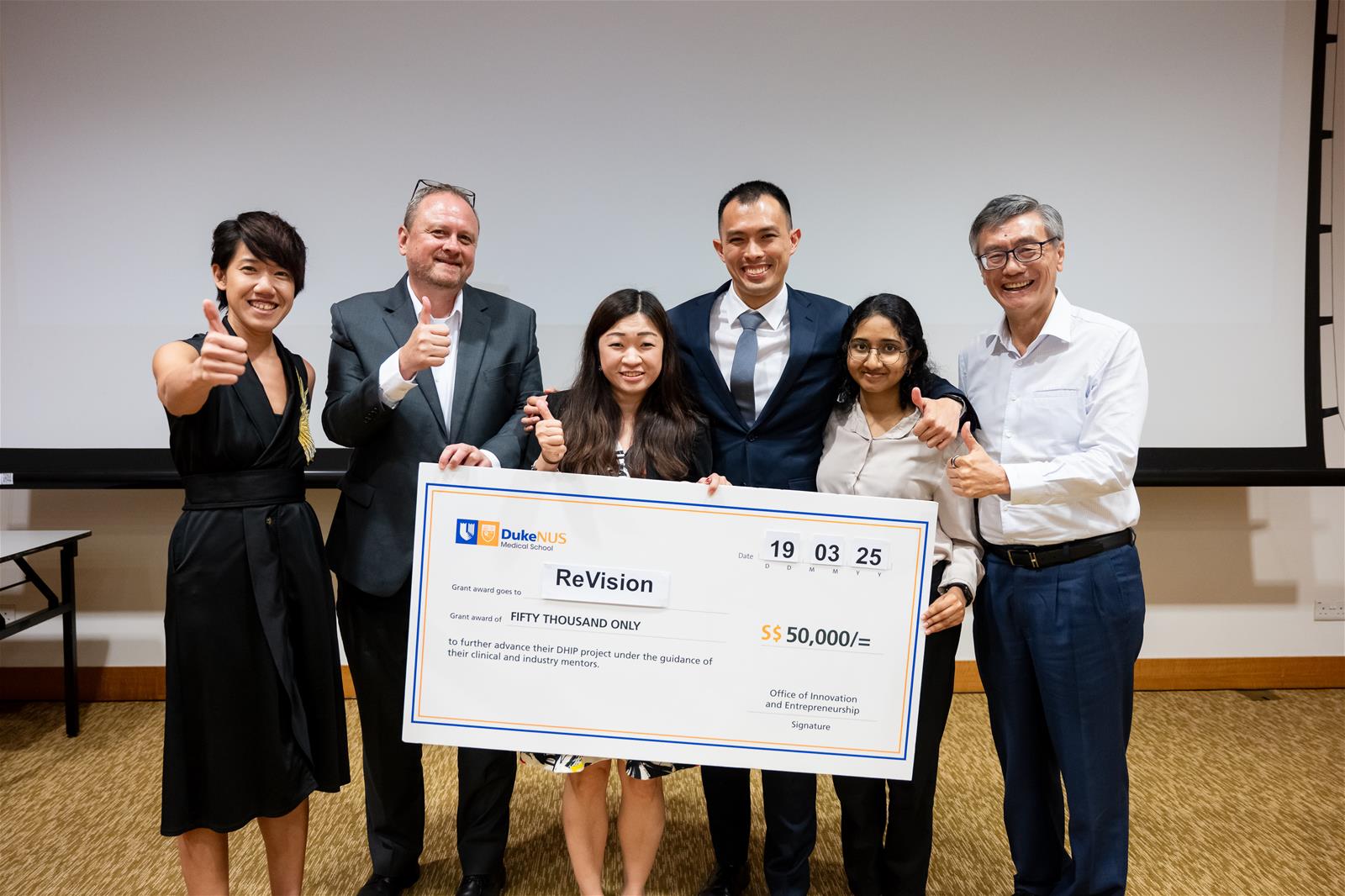

Yau and his team mates from Team ReVision were awarded $50,000 at this year’s Duke-NUS’ annual health innovator challenge // Credit: Duke-NUS

So what does the School look for in a student who may be a future clinician-innovator?

This work begins with creativity—the ingenuity and critical thinking needed to imagine solutions that do not yet exist. But creativity rarely emerges without a trigger. Charles Yau experienced this in D-HIP, where collaborating with engineers and business students sharpened his problem-solving and helped him see possibilities beyond the clinical.

For others, innovation is driven by frontline insight. Clinical Assistant Professor Ignasius Aditya Jappar from the SingHealth Duke-NUS Cardiovascular Sciences Academic Clinical Programme, has approached innovation through systems improvement, such as building more efficient ways to allocate telemetry access. His work illustrates that innovation in healthcare is as often about systems and processes as it is about devices.

Curiosity is another defining trait, adds Ignasius and Assistant Professor Wong Peiyan, who co-direct the first course in the Duke-NUS preclinical year, Foundation of Patient Care 1 (FPC1). They describe curiosity as the instinct to question how something might work better, notice an overlooked detail, or imagine an improved patient outcome—the spark that pushes ideas into territory where new solutions emerge.

Resilience also matters. As Assistant Professor Rena Dharmawan, Assistant Dean at OIE, notes, innovation requires the determination to iterate through trial and error, to navigate uncertainty, and to hold on to one’s nerve when the path is unclear. Hustle, she believes, is what carries innovators through uncharted terrain.

Prof Wang Linfa (left) and Asst Prof Matae Ahn (right) // Credit: Matae Ahn

Continuous learning anchors the mindset. Duke-NUS alumnus Kenneth Goh, now Associate Director, Search and Evaluation at JLABS Singapore, the global incubator network of Johnson & Johnson and an industry mentor for D-HIP students, describes successful innovators as “always interested in learning”, implying an openness that keeps ideas fresh and adaptable. 

For some, innovation is about impact. Matae Ahn, Nanyang Assistant Professor at the Lee Kong Chian School of Medicine, was once an MD-PhD candidate in Professor Wang Linfa’s lab at Duke-NUS. There he recognised that his research on bat immunology could lead to a new class of anti-inflammatory therapeutics. That possibility drew him into a career centred on translational research and innovation rather than a more predictable clinician-scientist path. It is a choice echoed by many early-career researchers across the School.

Together, these examples show that innovation among the medical students at Duke-NUS is not shaped by one archetype, but by the interplay of many perspectives—a mosaic of motivations and strengths. Yet individual qualities alone are not enough. What turns these instincts into capability is the educational environment designed around them.


How Duke-NUS cultivates the innovation mindset

Cultivating an innovation mindset at Duke-NUS begins with a shared understanding between the Office for Education and OIE—innovation in medicine is not a side interest, but a core professional literacy for future clinicians. This partnership ensures that innovation is embedded purposefully across the medical school journey.

As Professor Scott Compton, Senior Associate Dean for Medical Education, puts it: “Innovation is woven into the fabric of the Duke-NUS curriculum. It goes far beyond building devices. We teach every student to recognise unmet needs and develop ideas—and approaches—that can genuinely change patient care. That mindset is not an elective; it is core to how we train clinicians.”

The result is a multilayered learning environment. It begins in the classroom, where TELI, the School’s Technology Enhanced Learning & Innovation department, continually experiments with new approaches to teaching—including the use of 3D-printed anatomical models—to help students think creatively not only about scientific content but also about how knowledge can be understood, taught and applied.

Team-Based Learning (TBL) reinforces the habits encouraged by TELI. By placing students from diverse educational backgrounds into highly collaborative groups, TBL nurtures the habits that underpin innovation: shared problem-solving, openness to diverse perspectives, and the ability to build on one another’s ideas. As Laing often reminds his students and colleagues, innovation is a “team sport”, something that cannot depend on individual brilliance alone. A learning environment that cultivates these attitudes and skills lays an essential groundwork for an innovative mindset.


Building on this ethos, Duke-NUS has embedded innovation through its formal coursework. In their second year, students take an Innovation & Design Thinking module, which gives them structured tools for need-finding, user-centred design and early-stage problem solving. At the research and postgraduate level, a new Commercialisation & Entrepreneurship Certificate (CEC)—jointly developed by OIE and the Office for Education—introduces early-career researchers and budding clinician-innovators to the realities of translation: intellectual property, regulatory pathways, clinical validation, venture formation and the fundamentals of bringing an idea to market.

These academic pillars converge in D-HIP, which carries innovation from theory into practice. The Programme brings together students from medicine, engineering and business to tackle pressing clinical problems, guided by industry mentors, clinicians and innovation experts. The programme provides students with vital resources, connections and guidance as they take their first steps into innovation. For many students, D-HIP is the moment when innovation becomes tangible—when their classroom learning meets the real-world context of the problems they seek to solve.

Together, TELI, TBL, the Innovation & Design Thinking module, the CEC and D-HIP form a coherent ecosystem shaped jointly by Sarraf-Yazdi and Laing. Their collaborative approach ensures that innovation is “a core component of the School’s execution against its mission for medical education” – not a discrete activity, but a structural commitment.


Navigating uncertainty with courage

Innovation always carries risk. In biomedical innovation—a field where most drug-development start-ups fail—navigating risk is not optional; it is a necessary aspect of any innovative work.

Ahn’s career shift—from a clinician-scientist trajectory to a path more heavily centred on translational research and innovation—required him to embrace uncertainty, not only about the success of his innovations but also uncertainty in his career. As he puts it, “You always have to take risks because it’s new, you are doing a pioneering thing.” Without embracing that risk, nothing new can emerge.

Yau echoes this, highlighting the need for the space to fail—something young innovators may instinctively avoid in environments that prioritise measurable results. Programmes like D-HIP are designed to give students this protected space, supported by industry and clinical mentors, to help students learn through iteration.

For Dr Kenneth Goh, the training years are an ideal time to try different programmes, test ideas and attempt interesting projects, fail quickly and learn. // Credit: Kenneth Goh

Goh sees the training years as the ideal time to experiment—to try different programmes, test ideas and attempt interesting projects, fail quickly and learn. These experiences lend valuable perspective later in innovators’ careers. His “try before you buy” mindset encourages aspiring innovators to commit short periods of time to testing concepts. He notes, even excellent science can falter without a grounded understanding of how products fit into the day-to-day realities of clinical care. 

At Duke-NUS these views come together in a learning environment that encourages students to take thoughtful risks, grounded in mentorship and collaboration, creating the space for resilience, imagination and true invention to grow.


A vision for what’s next

Since innovation is seldom static, Duke-NUS continues to refine not only its medical innovation ecosystem, but the way it prepares future clinician-innovators. The Innovation & Design Thinking module now embedded in the second year of the MD programme, the new Commercialisation & Entrepreneurship Certificate Course for early-career researchers, and the  expansion of the D-HIP model across institutional and even geographical borders all point to the same trajectory.

These efforts collectively signal something deeper. Duke-NUS is not merely adding programmes; it is shaping the conditions that allow innovation to take root meaningfully and sustainably. As Laing observes, the real work of building a medical innovation ecosystem lies in ensuring that the structures surrounding students and trainees evolve as dynamically as the ideas they pursue.

This philosophy underpins OIE’s work. Duke-NUS’ goal, in Laing’s view, is not only to produce graduates who can innovate, but to cultivate an environment where the habits of innovation—curiosity, design thinking, problem-framing, resilience and interdisciplinary fluency—become the educational framework. Innovation, in this sense, is not a separate track, but a way of learning medicine.

Looking ahead, Laing imagines a future in which Duke-NUS graduates enter the healthcare and life science sectors with not only strong clinical foundations, but also an instinctive understanding of how to turn ideas into impact. Whether they join research groups or centres, collaborate with industry, or launch their own startups, their training will have prepared them to navigate the translation pathway with confidence. Such a marker, he notes, would signal a truly educational culture of innovation.

These aspirations reflect the broader shift needed across medical education. If future clinicians and researchers are to play a more active role in creating viable medical products, if scientists are to engage more confidently with entrepreneurs and investors, and if innovation is to be seen as a sustainable long-term career pathway, then our collective understanding of what it means to “train a doctor” must evolve and broaden.

Yau captures this shift succinctly: “I think perspective is so important when crafting innovations. You won't have all the answers. People and their experiences give you a different frame of reference and different insights to create something that works for a very different group of people from ourselves

Ultimately, all innovation begins with seeing in a new light. In medical education, that means teaching students to question assumptions, imagine new ways of looking at familiar problems, and approach familiar clinical challenges from multiple angles. With its focused efforts and expanding ecosystem, Duke-NUS shows that it is possible to teach not only the science of medicine, but the mindset that allows medicine to evolve.  

As Laing’s team often emphasises, “Perspective is what turns curiosity into impact.”

Get the latest news and features delivered to your inbox.

Browser not supported

Modern websites need modern browsers

To enjoy the full experience, please upgrade your browser

Try this browser